Es mostren les entrades ordenades per rellevància per a la consulta nudging. Ordena per data Mostra totes les entrades

25 de setembre 2013

Neither manipulated, nor influenced

Nudge and the Manipulation of Choice
A Framework for the Responsible Use of the Nudge Approach to Behaviour Change in Public Policy


When thinking on health behaviour change, the nudging approach is the trending topic. Let's remember the origins:
The contribution of Thaler and Sunstein’s Nudge, however, is not that of conveying novel scientific insights or results about previously unknown biases and heuristics (something that Thaler has championed in his academic publications. Instead, it is the notion of “nudge” itself, and the suggestion of this as a viable approach in public policy-making to influence citizens’ behaviour while avoiding the problems and pitfalls of traditional regulatory approaches.
A recent article explains details about two types of nudging:
Type 1 nudges and type 2 nudges. Both types of nudges aim at influencing automatic modes of thinking. But while type 2 nudges are aimed at influencing the attention and premises of – and hence the behaviour anchored in – reflective thinking (i.e. choices), via influencing the automatic system, type 1 nudges are aimed at influencing the behaviour maintained by automatic thinking, or consequences thereof without involving reflective thinking.
And both can be transparent or non-transparent.  An example of a transparent type 1 nudge is one used by the Danish National Railway agency. Speakers in city trains are used to announce “on time” when trains arrive on time. This nudge has been devised in order to get people to easily remember not just the negative, for example, when a train is delayed, but also the positive, when trains are on time. Non-transparent is closely related to manipulation of behavior and choice.

The authors conclude:

The characterization of nudging as the manipulation of choice is too simplistic. Both classical economic theory and behavioural economics describe behaviour as always resulting from choices, but the psychological dual process theory that underpins behavioural economics, used by Thaler and Sunstein, distinguishes between automatic behaviours, and reflective choices. Nudging always influences the former, but it only sometimes affects the latter. The conceptual implication of this is that nudging only sometimes targets choices.
That's a good point. More details inside the article.

PS Understanding the differences between:  Clinical Categorical vs. Regression Based patient classification systems.

PS. Waste vs. value by U. Reinhardt. Must read.


08 d’abril 2016

Introducing nudging in the law

Nudge and the Law. A European Perspective

Alberto Alemanno is an HEC law professor focused on issues on behavioral policies and regulation. Now he has edited an interesting book. You can check it from this index:

1. The Emergence of Behavioural Policy-Making:A European Perspective

Part I: Integrating Behavioural Sciences into EU Law-Making
2. Behavioural Sciences in Practice: Lessons for EU Rulemakers
3. Nudging and Evidence-Based Policy in Europe: Problems of Normative Legitimacy and Effectiveness
4 . Judge the Nudge: In Search of the Legal Limits of Paternalistic Nudging in the EU

Part II: De-Biasing Through EU Law and Beyond
5. Can Experts be Trusted and what can be done about it? Insights from the Biases and Heuristics Literature
6. Overcoming Illusions of Control: How to Nudge and Teach Regulatory Humility

Part III: The Impact of Behavioural Sciences on EU Policies
7. Behavioural Sciences and EU Data Protection Law: Challenges and Opportunities
8. Behavioural Sciences and the Regulation of Privacy on the Internet
9. EU Consumer Protection and Behavioural Sciences:Revolution or Reform?
10. What can EU Health Law Learn from Behavioural Sciences? The Case of EU Lifestyle Regulation
11. Conduct of Business Rules in EU Financial Services Regulation: Behavioural Rules Devoid of Behavioural Analysis?

Part IV: Problems with Behaviourally Informed Regulation
12 . Making Sense of Nudge-Scepticism: Three Challenges to EU Law ’ s Learning from Behavioural Sciences
13. Behavioural Trade-Offs: Beyond the Land of Nudges Spans the World of Law and Psychology
14. Epilogue: The Legitimacy and Practicability of EU Behavioural Policy-Making

The book deserves time reading it, specially if you are interested in latest trends on nudging and regulation. However, if you don't have enough time, go straight to chapter 10. This is what you should read about implications of nudging on Public Health. He says,
Our previous analysis made a case for more experimentation in behaviourally informed regulation in the EU lifestyle policy. This seems particularly true when examined in light of the limited results attained by self-regulatory schemes led by the food, alcohol, and tobacco industries. While the evidence of what works in terms of behaviour change strategies is limited and too often anecdotal, several success factors have progressively been identified in policy-making.
 These success factors are those we have to check in our close environment and test wether it is worth taking this regulatory approach.


10 de setembre 2014

Is nudging ethical?

The challenges and opportunities of ‘nudging’

A forthcoming Editorial in the Journal of Epidemiology and Community Health provides some amunition for those interested on nudging.
The answer to the question if nudging is an ethically acceptable way of governing people’s behaviour depends on the ethical principles one adheres to. Our core point is that there is no magic trick, any form of policy intervention will impose a criterion against someone’s will, and democracy requires: (1) transparency from the political system in terms of the values selected in deciding and designing an intervention; (2) and at least an evidence-based justification of choice.
If the preferences of an individual change, then we cannot state that his first choice is better/equal/worse than his second one without introducing a ranking among his preference systems. As a result, value-free interventions cannot be defined.
If no magic bullet is available on the policy side, the same applies to research. In the domain of health, behavioural approaches must cope with the challenge of not neglecting the socioeconomic and contextual determinant of health inequalities
We argue that neglecting socioeconomic variables would be clearly a mistake also in the design of nudge. However, our point is precisely that behavioural science (and nudge as its policy implication) can incorporate an analysis of social and cultural factors, and avoid cognitive universalism.
Easier said than done. For an op-ed, it fits with the audience, for a strict and concrete policy recommendation requires further elaboration. I can't see  a practical and concrete applicable approach nowadays. Let's continue waiting.

PS. Must read, on medical devices in BMJ.A systematic review of new implants in hip and knee replacement

PS. A flawed PNAS article unveiled. Again and again, where is peer-review?

Jordi Pintó at Galeria Banadas

02 de juny 2017

Compensating behaviour after nudging

Nudges that fail

Cass Sunstein shows in his las published article that nudging may fail, and explains the reasons and what to do. Great, I was waiting for that, because we need to disentangle the current approaches to nudging. the article tries to shed light, but in the end, uncertainties remain.

The general point is that any form of choice architecture, including the use of default rules, may have little or no net effect if people are able to find otherdomains in which to counteract it. The idea of compensating behavior can be seen as a subset of the general category of strong antecedent references, but it points to a more specifi c case, in which the apparent success of the nudge is an illusion in terms of what choice architects actually care about (Hirschman,1991).
What matters is welfare, not effectiveness (Sunstein,2016). A largely ineffective nudge may have positive welfare effects; an effective nudge might turn out to reduce welfare. A strong reason for nudges, as distinguished from more aggressive tools, is that they preserve freedom of choice and thus allow people to go their own way. In many contexts, that is indeed a virtue, and the ineffectiveness of nudges, for some or many, is nothing to lament. But when choosers are making clear errors, and when third-party effects are involved, the ineffectiveness of nudges provides a good reason to consider stronger measures on welfare grounds.
 Therefore with this text Sunstein is landing to the practical difficulties on nudging. Highly recommended.

PS. Congratulations to Adam Oliver, C. Sunstein and G. Akerloff for the new journal.


Pissarro à Eragny - La nature retrouvée
Au Musée de Luxembourg maintenant

13 d’octubre 2022

The architects of choice

Nudging

How “nudges” by government can empower citizens without manipulating their preferences or exploiting their biases.

We're all familiar with the idea of “nudging”—using behavioral mechanisms to encourage people to make certain choices—popularized by Richard Thaler and Cass Sunstein in their bestselling 2008 book Nudge. This approach, also known as “libertarian paternalism,” goes beyond typical programs that simply provide information and incentives; nudges can range from automatic enrollment in a pension plan to flu-shot scheduling. In Nudging, Riccardo Viale explores the evolution of nudging and proposes new approaches that would empower citizens without manipulating them paternalistically. He shows that we can use the tools of the behavioral sciences without abandoning the principle of conscious decision-making.

A controversial approach. 


05 de gener 2015

Understanding the autopilot and nudging it

Nudging: A Very Short Guide


Today I would suggest you to spend one hour watching an excellent documentary about "The magic of unconscious", in catalan here until Jan 9th, and in english here.

Cass  Sunstein recently has published the short guide to nudging and those interested in any concrete application should look at these ten tools:
1. Defaults
2. Simplification
3. Social norms
4. Increases in convenience
5. Disclosure
6. Warnings
7. Precommitments
8. Reminders
9. Eliciting intentions
10. Informing people of the nature and consequences of their own past choices.
Wether they may work or not depends on the details and environment. The hardest task.


12 de gener 2015

Involved in our own health

People in control of their own health and care

 From King's Fund report:


Different perspectives (p.11)
• A consumerist approach: health and health care is seen as a marketplace in which patients (consumers) are involved by making choices about services, and the health care market responds to their preferences. Patient involvement is then a means to improve quality.
• A democratic approach: people have political, social and economic rights as citizens, and those who use or are affected by a public service should be involved in how it is run, and have certain rights regarding what they receive from that service.
• An ethical and outcomes-based approach: involvement is seen as the ethical thing to do, and the best approach to improve outcomes. This means recognising that good care comprises the application to individual circumstances of evidence-based medicine along with knowledge and experience. Patient involvement is essential to the judgement of relative risk and benefit associated with decision-making.
• A value-based approach: to achieve truly the best value for money from our health and care system, we must know and respond to what people need and want. In this way, we can deliver care that meets their preferences and patients receive ‘the care they need (and no less), and the care they want (and no more)’ (Mulley et al 2012).
• An approach based on sustainability: it is increasingly difficult for health systems to provide the best possible care to everyone as the prevalence of long-term conditions increases and the population ages. By involving people in managing their own health and care, and keeping well and independent, we can minimise our use of services.
• A person-centred care approach: our health and care system should be  focused on its users, promoting independence and co-ordinated around people’s full needs rather than being fragmented and siloed. Patient involvement is an essential component of delivering a more person-centred service that is tailored and responsive to individual needs and values.
The forgotten perspective in the list, though quoted in the text (p.16):  A behavioural economics approach: we try to do our best for our health but the autopilot decides without our full control. Some help (nudging) is needed.

The message:  "Embarking on an honest conversation about rights and responsibilities requires consideration of people’s motivation and the capability to engage."

PS. Nudging and the European Union, by Alberto Alemano.

PS. BIT Publication: EAST.Four simple ways to apply behavioural insights

PS. Regarding Hepatitis C treatment costs, It is good to remember this post by U. Reinhardt:


With this offer curve, a health system confronts the rest of the nation with two morally challenging questions:
1. Is there a maximum price above which society no longer wishes to purchase added QALYs from its health system, even with the most cost-effective treatments (e.g., Point C)?
2. Should that maximum price be the same for everyone, or could there be differentials – for example, a lower maximum price for patients covered by taxpayer-financed health programs (e.g., Medicaid, Tricare, the Veterans Administration health system and perhaps Medicare), a wide range of higher prices for premium-financed commercial insurance, depending on the generosity of the benefit package that the premium covers, and yet higher prices for wealthy people able to pay out of their own resources very high prices to purchases added QALYs for the family?


24 de gener 2026

La manipulació com a robatori

Manipulation: What It Is, Why It's Bad, What To Do About It 

L'obra "Manipulation: What It Is, Why It's Bad, What To Do About It" (2025), escrita per Cass R. Sunstein (pioner de la teoria de l'impuls o nudge), analitza com les noves tecnologies ofereixen oportunitats sense precedents per manipular els ciutadans, comprometent la seva llibertat i el seu benestar. El llibre s'estructura en tres parts: teoria, aplicacions i futur.

I. Teoria: Definint la Manipulació

Sunstein argumenta que, tot i ser un concepte difícil de delimitar, la manipulació es diferencia clarament de la coacció i de la persuasió racional.

  • Definició principal: L'autor proposa que la manipulació és una forma de truc o engany, destinada a afectar el pensament o l'acció, que no respecta la capacitat de l'individu per a la tria reflexiva i deliberativa.
  • Sistema 1 vs. Sistema 2: El llibre utilitza el marc de la ciència conductual per explicar que els manipuladors solen apuntar al Sistema 1 (automàtic, intuïtiu i propens a biaixos) per esquivar el Sistema 2 (deliberatiu i calculador).
  • Per què és dolenta? Segons les fonts, és èticament qüestionable perquè insulta l'autonomia i la dignitat de les persones, tractant-les com a "eines o necis" (tools and fools) en lloc d'agents sobirans. Des d'una perspectiva de benestar, el manipulador sol ignorar els gustos i valors reals de la víctima, imposant els seus propis objectius.
  • Un nou dret: L'autor proposa el reconeixement d'un dret moral i legal a no ser manipulat, especialment en l'àmbit digital.

II. Aplicacions: Enganys i Barreres

Sunstein analitza tres fenòmens moderns on la manipulació és omnipresent:

  1. Deepfakes: Són productes de la IA que creen imatges o vídeos falsos però d'aparença real. L'autor els considera una forma de manipulació "insidiosa" perquè exploten el biaix de veritat de l'ésser humà (la tendència a creure el que veiem) i poden causar danys greus a la reputació i a la democràcia.
  2. Sludge (Fang o Residu Administratiu): Es refereix a les friccions o barreres burocràtiques (com formularis excessivament complexos o dificultats per cancel·lar subscripcions) que impedeixen que la gent faci el que vol. El sludge és una eina de manipulació que roba temps i diners explotant la inèrcia i el biaix del present. Sunstein advoca per fer "Auditories de Sludge" per simplificar la vida dels ciutadans.
  3. El problema de la Barbie (Pressió Social): Descriu situacions on la gent és manipulada per comprar béns o participar en activitats (com les xarxes socials) que desitjarien que no existissin, però que consumeixen per por a l'exclusió o per evitar enviar un senyal social negatiu.

III. El Futur: IA i Nudging Ètic

El llibre tanca explorant com la societat es pot protegir en el futur:

  • Nudging sense manipulació: Sunstein defensa que no tots els impulsos (nudges) són manipuladors. Els recordatoris, les advertències factuals o les auditories de navegabilitat són eines que promouen l'agència en lloc de soscavar-la.
  • Intel·ligència Artificial: Presenta una dicotomia. Per una banda, la IA pot crear "Motors de Decisió" (Choice Engines) personalitzats que ajudin a les persones a superar els seus biaixos i a prendre millors decisions segons els seus propis criteris. Per l'altra, la IA té un potencial "fresc i amenaçador" per explotar les vulnerabilitats humanes de manera quirúrgica.

En conclusió, el llibre és un crit d'alerta contra la manipulació entesa com una forma de robatori de l'autonomia personal. Sunstein sosté que, en l'era dels algorismes, la transparència i l'escrutini públic són els únics salvaguardes efectius per garantir que les persones continuïn sent els autors de les seves pròpies vides.


22 de desembre 2014

Thinking and deciding

World Development Report 2015: Mind, Society, and Behavior

Our decision making patterns are based on multiple foundations. The new WB report summarises them in three sources: automatic, social and mental models.  In chapter 8 you'll find applications to health. Some of them may be naive, while others potentially useful. There is a trial and error process in all this stuff because of cultural implications. If there is a particular area to focus on, it is on health communication for behavioural change. There is a lot to learn from behavioral economics:
Understanding that people think automatically, interpret the world based on implicit mental models, and think socially allows policy makers to make major strides in improving health outcomes. Individuals sometimes value information highly (for example,
when seeking curative care), but at other times providing information is not sufficient to get people to change behaviors that undermine health. Framing effects that make social expectations and social approval more salient can sometimes encourage individuals to seek preventive care and adhere to treatment when they otherwise would not, even though the individual benefits exceed the individual cost.
PS. My former posts on nudging

PS. Post by BIT.

PS. TE on poor behavior.

PS. Excellent "30minuts" documentary about the Snowden's massive information leak ever. (Only until Dec 28th)


25 de juny 2019

Behavioral insights

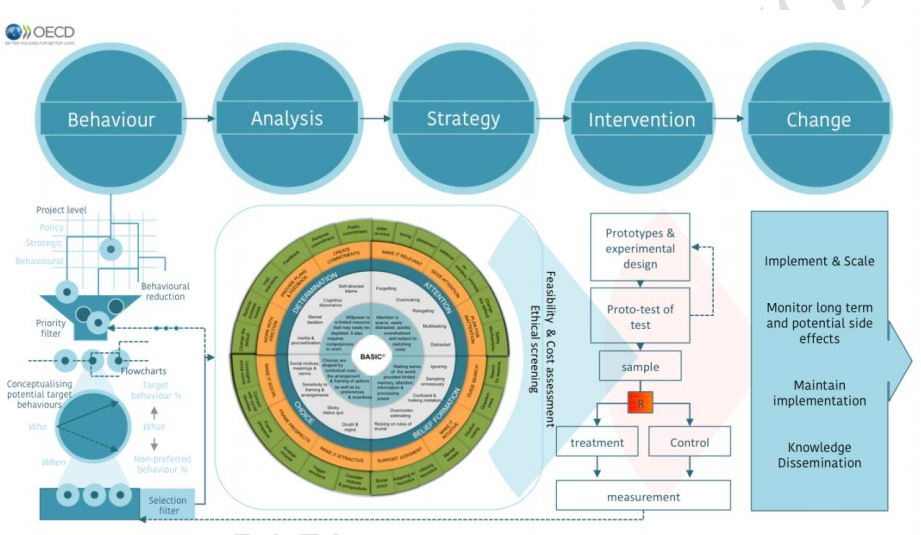
BEHAVIORAL INSIGHTS. BASIC TOOLKIT AND ETHICAL GUIDELINES FOR POLICY MAKERS

This OECD report is really helpful. It tries to provide a concret approach to behavioral insights for policy makers. It goes beyond standard nudging perspective.


16 de gener 2015

The politics of calories

Why Calories Count

Marion Nestle says in her book:
In some ways, the calorie environment could not have been more brilliantly constructed to overcome physiological controls of overeating.
The new labeling initiatives have been really minor up to now. Wether they will have beneficial effects in the long run is still unknown. Calorie labeling should be extended when eating outside home and to alcohol.
The government has not paid enough attention to food regulation and specially to information about calories. In the book there is a guide for improvement. This is the previous step in any nudging effort. To be clear, information disclosure is the very beginning of any consumer protection and health promotion policy in this field.


28 d’abril 2024

Repassant temes de política sanitària

 Handbook on the Political Economy of Health Systems

Llibre suggerent, amb aquest índex:


PART I INTRODUCTION TO THE POLITICAL ECONOMY OF HEALTH SYSTEMS

1 An introduction to the Handbook on the Political Economy of Health Systems 2


PART II CONSTITUTIONAL DESIGN OF HEALTH CARE SYSTEMS

2 Health and healthcare as a human right 12

3 Do democratic regimes exhibit ‘better’ health outcomes? 27

4 Soviet communism and later-life health and health care 42

5 Federalism and tax-financed healthcare: economic advantages, dilemmas, and solutions 57

6 The coordination in European Union healthcare after Covid-19 70

7 Efficiency and equity effects of healthcare decentralization: evidence from Italy 85

8 Political economy of health care insurance expansion in Mexico 112

9 Weird health care for WEIRD societies? 130


PART III POLITICAL INSTITUTIONS, POLITICAL MARKETS AND HEALTH CARE DECISIONS

10 Medical composition of cabinets and the health care system 147

11 Women politicians and public health 157

12 Community and civic participation effects on health and well-being 177

13 Ideology and health spending 200

14 Lobbying, health, and healthcare 213

15 Healthcare corruption 236

16 Provider power and healthcare systems 247

17 Health effects of trade policy and corporate interest groups 270

18 Institutional quality and health outcomes 292


PART IV THE POLITICAL ECONOMY OF HEALTH CARE FINANCING AND POLICY REFORMS

19 Towards a general political economy of private supplementary health insurance 319

20 Political economy of public financing of health in low- and middle-income countries 339

21 Political economy of health system reform: evidence from Spain 370

22 The pharmaceutical patent system and access to medicines 380


PART V POLITICAL ECONOMY OF HEALTH CARE DURING COVID-19

23 Covid-19 and the interest group approach to government 397

24 Political preferences and nudging for healthcare: evidence from Covid certificates 412

25 Multilevel governance in the first wave of Covid-19 430


PART VI LESSONS FROM THE HANDBOOK

26 The political economy of health systems: research space, goals and lessons 447


17 de desembre 2020

Nudging effectiveness

 The effectiveness of nudges in improving the self-management of patients with chronic diseases: A systematic literature review

From a review article:

We identified 26 studies, where 13 were of high or moderate quality. The most commonly tested nudges were reminders, planning prompts, small financial incentives, and feedback. Overall, 8 of 9 studies with a high or moderate quality ranking, focused on self-management outcomes, i.e., physical activity, attendance, self-monitoring, and medication adherence, found that nudges had significant positive effects.However, only 1 of 4 studies of high or moderate quality, analyzing disease control outcomes (e.g.,glycemic control), found that nudges had a significant positive effect for one intervention arm.In summary, this review demonstrates that nudges can improve chronic disease self-management, but there is hardly any evidence to date that these interventions lead to improved disease control. Reminders,feedback, and planning prompts appear to improve chronic disease self-management most consistently and are among the least controversial types of nudges.

And the message:

 There is hardly any evidence to date that these interventions lead to improved disease control.

So now what?


Cartier Bresson
 

01 d’octubre 2025

Manual de política sanitària (2)

Health Policy Analysis: An Introduction

 El llibre "Health Policy Analysis: An Introduction" de Hans Maarse, publicat per Maastricht University Press el 2023, és una introducció a l'anàlisi de la política sanitària. El seu propòsit principal és familiaritzar els estudiants amb els conceptes i models necessaris per estudiar les eleccions i l'elaboració de polítiques sanitàries des d'una perspectiva política.

La tesi central del llibre és que la creació de polítiques sanitàries implica més que la mera traducció de coneixements empírics sobre els determinants de la salut i la malaltia en mesures polítiques efectives. No hi ha un camí lineal del coneixement a la política sanitària, ja que la política sanitària és el resultat de conteses polítiques, creences ideològiques, interessos comercials, poder i pràctiques institucionalitzades. L'objectiu és formar els estudiants per analitzar l'impacte d'aquests factors en la formulació de polítiques sanitàries.

El llibre es divideix en tres parts principals: Introducció, Blocs de Construcció i Models d'Anàlisi de Polítiques Sanitàries.

Part Un: Introducció

  • Capítol 1: La  Salut Pública
    • Explica com els actors públics han augmentat la seva implicació en la salut pública des del segle XIX, un fenomen anomenat "publicitació de la salut pública".
    • Defineix la salut pública com la magnitud i distribució de la salut i la malaltia a nivell de població o subpoblació.
    • Argumenta que la política sanitària és una acció col·lectiva influenciada per factors contextuals com els culturals, tecnològics, econòmics, demogràfics, polítics i globals.
    • Presenta un model analític de salut pública basat en el concepte de camp de salut de Lalonde, que mostra que la salut està influenciada per sis factors principals (biològics, biosfera/atmosfera, socioeconòmics, ambientals, conductuals i de salut).
  • Capítol 2: Anàlisi de Polítiques Sanitàries
    • Defineix l'anàlisi de polítiques sanitàries com l'anàlisi de i per a la formulació de polítiques sanitàries, amb l'objectiu d'adquirir coneixement empíric que pugui ser utilitzat en la pràctica.
    • Distingueix entre coneixement sobre el problema (pertinent a una política específica) i coneixement sobre l'elaboració de polítiques (com es prenen les decisions). El llibre se centra en la dimensió de l'elaboració de polítiques.
    • Introdueix el model conceptual de l'anàlisi de polítiques sanitàries del llibre, que combina cinc "blocs de construcció" (política sanitària, procés, actors, governança i efectes) amb quatre "models analítics" (racional, normatiu, de conflicte i institucionalista).

Part Dos: Blocs de Construcció

  • Capítol 3: Política Sanitària
    • Defineix la política sanitària com l'esforç col·lectiu dels responsables polítics per assolir objectius de salut mitjançant instruments durant un període de temps.
    • Aborda els problemes de salut com a constructes polítics.
    • Distingeix entre problemes estructurats, moderadament estructurats i no estructurats.
    • Analitza els objectius polítics (a curt, mitjà i llarg termini, intermedis i finals, quantificats i no quantificats).
    • Descriu els instruments polítics (basats en l'autoritat, el tresor, la informació i l'organització), incloent el "nudging" com a instrument nou.
    • Posa èmfasi en el paradigma polític (conjunt de suposicions subjacents) i la narrativa política per legitimar la intervenció pública i generar suport.
  • Capítol 4: Procés de Formulació de Polítiques Sanitàries
    • Defineix el procés de formulació de polítiques com la dinàmica d'esdeveniments, decisions i accions relacionades amb la salut pública.
    • Presenta el model d'etapes (o fases): construcció de l'agenda, desenvolupament de polítiques, formació de polítiques, implementació de polítiques, avaluació de polítiques i terminació de polítiques.
    • Introdueix models alternatius com el model de rondes i el model d'intersecció ("crisscross").
    • Detalla cada etapa, des de com els problemes arriben a l'agenda política fins a l'avaluació i possible terminació d'una política.
  • Capítol 5: Actors en l'Arena de la Política Sanitària
    • Defineix un actor com un individu o organització que participa en l'elaboració de polítiques sanitàries.
    • Classifica els actors en set categories principals: responsables polítics, experts, organitzacions d'interès (i lobbistes), grups de ciutadans, organitzacions productores, mitjans de comunicació i poder judicial.
    • Explora el concepte de xarxes de polítiques (o subsistemes de polítiques) com a forma de coordinació entre actors.
    • Analitza el paper de cadascun d'aquests actors, incloent l'arena de la política sanitària internacional i el paper de l'OMS i la Unió Europea.
  • Capítol 6: La Governança de la Formulació de Polítiques Sanitàries
    • Defineix la governança com el sistema de regles (regles de governança) per a la producció de polítiques públiques.
    • Aborda el concepte de bretxa de governança (manca d'ajust entre l'estructura de governança existent i la requerida) i el seu impacte en la capacitat de resolució de problemes dels sistemes de salut.
    • Classifica les regles de governança (autorització, participació, decisió, compliment, coordinació, finançament, transparència, rendició de comptes, integritat i protecció legal).
    • Descriu models de governança segons el mode de presa de decisions i compliment (anàrquic, jeràrquic, de votació per majoria, de xarxa i de mercat).
    • També presenta models segons el locus de la presa de decisions (governança estatal, autogovern, estat-local i corporatista).
    • Examina la centralització i descentralització com a enfocaments de reforma de la governança.
    • Discussió de la governança global i els seus límits.
  • Capítol 7: Efectes de la Política Sanitària
    • Defineix els efectes de la política com els canvis atribuïts a l'ús d'instruments polítics.
    • Distingeix entre resultats polítics (output) i efectes polítics (outcomes).
    • Analitza l'eficàcia de la política sanitària i les causes del fracàs polític.
    • Explora els efectes secundaris, contraproduents i distributius de la política.
    • Considera els costos administratius.
    • Analitza el rendiment del sistema de salut (efectivitat, qualitat, responsabilitat, equitat i productivitat) i la resiliència del sistema de salut.
    • Aborda els efectes polítics de la política sanitària, inclosa la confiança política.

Part Tres: Models en l'Anàlisi de Polítiques Sanitàries

  • Capítol 8: El Model Racional en l'Anàlisi de Polítiques Sanitàries
    • Destaca el paper crític de la informació en la formulació de polítiques sanitàries.
    • Presenta el model sinòptic (presa de decisions com una sèrie de passos lògics per trobar la solució òptima).
    • Ofereix el model deliberatiu com a alternativa, subratllant la importància de l'argumentació, la interpretació, la defensa múltiple i la justificació.
    • Explora la relació entre observació, informació i interpretació ("sense-making").
    • Analitza les múltiples fonts i la utilització de la informació pels responsables polítics.
    • Discuteix l'elaboració de polítiques basada en l'evidència i les seves contribucions i límits.
    • Aborda la incertesa i el risc com a elements inherents a tota política sanitària, i les estratègies per gestionar-los.
  • Capítol 9: El Model Normatiu en l'Anàlisi de Polítiques Sanitàries
    • Postula que la formulació de polítiques sanitàries és una activitat lligada a valors i implica judicis morals.
    • El model conceptualitza la política sanitària com el resultat de decisions normatives inspirades en creences morals.
    • Estudia els judicis morals com a fenòmens empírics.
    • Defineix i distingeix entre valors (últims i instrumentals) i normes (morals, legals i socials).
    • Identifica dilemes morals comuns en la política de salut pública: drets individuals vs. comunitaris, equilibri entre beneficis/danys/riscos/costos, paternalisme vs. responsabilitat individual, privadesa vs. salut pública, i priorització.
    • Analitza la politicització dels conflictes normatius i el paper limitat de l'evidència per resoldre'ls.
  • Capítol 10: El Model de Conflicte en l'Anàlisi de Polítiques Sanitàries
    • Postula que la formació de polítiques sanitàries és el resultat d'un conflicte.
    • Conceptualitza el conflicte com a condició (preferències incongruents) i com a procés (emergència, lluita, resolució).
    • Classifica els tipus de conflictes (morals, informatius, de límits, distributius, de coordinació, de poder) i els que tenen o no un interès comú.
    • Examina l'impacte dels conflictes en la capacitat de resolució de problemes dels sistemes de salut.
    • Aborda la politicització de la ciència, on la ciència esdevé un instrument o objecte de conflicte polític.
    • Descriu diverses estratègies de resolució de conflictes (decisions jeràrquiques, votació per majoria, acord negociat, arbitratge, litigis, evitació).
    • Analitza el concepte de poder (capacitat de determinar el comportament d'un actor, poder de l'agenda, control del pensament) i els seus recursos.
    • Explora el canvi en l'equilibri de poder en l'arena de la política sanitària (augment del poder de l'Estat, declivi del poder mèdic, ascens del sector mèdic corporatiu i interessos comercials).
  • Capítol 11: El Model Institucionalista en l'Anàlisi de Polítiques Sanitàries
    • Defineix les institucions com regles de joc àmpliament acceptades que donen direcció a l'acció social (sistemes de creences i patrons d'interacció).
    • Conceptualitza el sistema de salut com un sistema institucionalitzat.
    • Aborda l'institucionalisme pluralista i la incompatibilitat institucional.
    • Analitza la relació recíproca entre l'estructura institucional i l'elaboració de polítiques sanitàries.
    • Presenta tres versions del model institucionalista: racional, sociològic i històric.
    • Explica la continuïtat institucional (resistència al canvi).
    • Investiga el canvi institucional, incloent les causes i els models de transformació gradual (deriva, estratificació, desplaçament, conversió i esgotament).

En conclusió, el llibre de Maarse és una guia exhaustiva per a l'anàlisi de polítiques sanitàries, que transcendeix una visió purament instrumental i tècnica, emfatitzant la dimensió política, contextual i dinàmica de la formulació de polítiques de salut mitjançant marcs conceptuals i models analítics.


25 de març 2013

Choice architecture

A Nudge Too Far? A Nudge at All? On Paying People to Be Healthy

Is there a need to change "choice architecture" to adopt healthy behaviours?. From behavioral economics perspective, the answer is yes. However, the doubt is over how it should be done.  The lead article on HealthcarePapers is about pushing healthy behaviours. I'm not a fan of financial incentives for these issues. The article hightlights pros and cons, a good review for any newcomer to the field.
From all the comments, Pierre-Gerlier Forest poses a difficult trade-off between the role of the democracy and "nudging" by experts. Unfortunately, he gives no answer and waits for pragmatic improvements.Meanwhile, have a look at this article: beyond nudges, "tools for a choice architecture".

PS. Check "I nudge you".

14 d’octubre 2013

Behavioural economic-informed regulation

From Nudging to Budging: Using Behavioural Economics to Inform Public Sector Policy

Is it possible to design a regulatory mechanism to budge the private sector away from socially harmful acts?. Adam Oliver, from LSE offers his view at the Journal of Social Policy:
The role of government is not, for the most part, to interfere with personal lifestyle choices unless those choices present harms – or negative externalities – to others, although the government may be warranted in enforcing some behaviours designed to protect people principally from themselves if the intervention is considered openly and explicitly and supported widely, such as seatbelt legislation. The most effective way of preventing people or organisations harming others is to regulate their activities. Nudge is anti-regulation, but behavioural economics is not.
An awareness of the main behavioural economic findings – for example, present bias, reference points, loss aversion and nonlinear probability weighting – can help to inform decisions on where and how to regulate (for instance, traffic light food labelling), and may also ensure that public officials gain a better understanding of their own decision making limitations.
As I have said before, the idea sounds appealing, its implementation remains uncertain.

14 d’octubre 2017

The end of marginal revolution

Richard Thaler was awarded with the Nobel Prize some days ago. If you follow this blog you'll know his works on behavioral economics and nudging. Since many years I've been interested in this perspective, though it has still more to deliver.
Today I would suggest you to read JM Colomer blog. He has written an excellent post on him and its impact on economic science. Selected statements:
Marginalist microeconomics held that we could understand collective outcomes by assuming that they derive from free interactions among homines economici.
A first big counter-revolution was the reintroduction of institutions in the basic analysis, especially since the 1980 and 1990s (including by Nobel laureates related to the social choice and public choice schools such as Kenneth Arrow, James Buchanan, Ronald Coase, Douglass North, Amartya Sen, Thomas Schelling, Leonid Hurwicz, Roger Myerson, political scientist Elinor Ostrom, Oliver Williamson, and others).
The second is the reintroduction of realistic observations about people’s motivations and behavior, including emotions. This has been based on psychology, on the background of huge progress in neuroscience (while pioneers include political scientist Herbert Simon and psychologist Daniel Kahneman). That Richard Thaler professes at the University of Chicago, once the temple of the neoclassical school, shows the depth of the change.
Now we know again that the three pillars of social analysis are, together with people’s calculated self-interested choices, emotions and institutions, as Hume and Smith masterfully had already established.
And this is the return to the roots of economics with a new toolkit.


Parov Stelar

12 de maig 2021

Health behaviors and behavior change

 Behavioral Economics and Public Health

Health behaviors and practices constitute the foundation of good physical and mental health. The leading contributors to the global burden of disease include tobacco smoking, low-quality diets, alcohol abuse, physical inactivity, and obesity. Accordingly, encouraging people to adopt—and maintain—healthy behaviors is a major objective of public health. 

Today I recommend this book and this is what you'll find inside:

Chapter 1: An Introduction to Behavioral Economics and Public Health. Christina A. Roberto and Ichiro Kawachi

Chapter 2: Intertemporal Choices for Health. Justin S. White and William H. Dow

Chapter 3: Maintenance of Healthy Behaviors: Forming and Changing Habits. Dennis Rünger and Wendy Wood

Chapter 4: Emotions and Health Decision-Making: Extending the Appraisal Tendency Framework to Improve Health and Health Care. Rebecca Ferrer, William Klein, Jennifer Lerner, Valerie Reyna, and Dacher Keltner

Chapter 5: Social Norms, Beliefs, and Health. Brent McFerran

Chapter 6: Communicating for action: the importance of memorability and actionability. Jason Riis and Rebecca K. Ratner

Chapter 7:Nudging Individuals Toward Healthier Food Choices with the 4Ps Framework for Behavior Change. Zoë Chance, Ravi Dhar, Michelle Hatzis, and Kim Huskey

Chapter 8: Incentivizing Health Behaviors. Kristina Lewis and Jason Block

Chapter 9: Slim By Design: Moving from Can't to CAN.Brian Wansink

Chapter 10: Applying Behavioural Economics in a Health Policy Context: Dispatches from the front lines. Michael Sanders and Michael Hallsworth

Chapter 11: From Choice Architecture to Policy Infrastructure: Multi-Level Theory and the Political Economy of Health Behaviors. Frederick J. Zimmerman


03 de juliol 2023

Els incentius per a un comportament saludable

 Behavioural Incentive Design for Health Policy

L'economia del comportament ha estat tema estrella de l'economia des de fa uns quants anys. Ara bé, ha tingut i té els seus moments, uns millors i altres pitjors. Va ser objecte de reconeixement al Premi Nobel diverses vegades, però també de frau (aquesta setmana) o controvèrsia i crítica. 

I el més important, la forma com es tradueix la teoria amb implicacions per a la pràctica ha estat també desigual. Ara el nou llibre que acaba de publicar en Joan Costa i col·laboradors, omple un buit sobre la qüestió.

 I tracta d'això:

1 Behavioural Incentives and Health: The ‘Science’ of Health Incentive Design? 

2 Behavioural Learning and the Design of Incentives

3 Monetary Incentives for Health

4 Social Incentives for Health Behaviours

5 Nudging for Better Health

6 Social Preferences and Health

7 Behavioural Incentives for Health Behaviours

8 Behavioural Anomalies in the Demand for Health Care

9 Behavioural Anomalies in the Healthcare Supply

10 Behavioural Health Insurance Uptake

11 Ageing and Caregiving Decisions Over Time

12 Policy Applications from a Global Perspective

Només veient l'índex hom ja es pot imaginar que el llibre posa ordre a les idees amb una estructura clara. I si mireu l'interior observareu encara missatges que són d'utilitat per a la política sanitària i la salut pública.

Si ja sabem de fa molt que el comportament humà s'allunyà dels patrons esperables de la racionalitat, la qüestió és com es pot resoldre això en l'àmbit de la salut. Doncs si voleu pistes, en aquest llibre les trobareu. N'hi ha d'altres, però menys encertats o enfocats als USA. 

PS El llibre és el resultat del curs que fan a LSE.